2880 Acton Road,



A Wet Oil Pan on Your Honda or Toyota in Birmingham Is Three Different Repairs
Oil on the bottom of the pan tells you where gravity put it, and almost nothing about where it came from. Three faults produce the same wet aluminum, and they cost very different amounts to put right: the pan-to-block joint, the drain plug, and oil that started higher up and ran down.
Getting that call wrong is how an owner pays for a pan gasket and still finds a spot on the driveway a week later.
Quick Summary: Key Takeaways
- Clean it first, then look: a wet pan hides its own source until the oil is washed off and the car is driven again.
- Most Hondas and Toyotas have no pan gasket: the pan is sealed to the block with a bead of liquid sealant, so the repair means scraping and re-sealing the seam.
- Drain plugs fail two ways: a crush washer that was reused, or threads that were pulled by an over-tightened plug.
- Oil runs downhill: a leak at the timing cover, the cam plug or the filter housing ends up on the pan too.
Most of these engines have no oil pan gasket at all
Owners ask for an oil pan gasket and most of these engines do not have one. Honda’s J-series and K-series, and the Toyota and Lexus engines alongside them, seal the pan to the block with a bead of liquid sealant laid down at the factory. That bead hardens with age and heat cycling, and it lets go first at the corners where the pan meets the block and the transmission bellhousing.
A reseal is a real job. The pan has to come off, which on a transverse V6 often means dropping a subframe cradle or at least supporting the engine, then every trace of the old sealant has to be scraped off both surfaces. Rushing that step is the single most common reason a resealed pan leaks again.
Drain plugs cause more of these leaks than people expect
Look at the plug before anyone quotes a pan. The aluminum or copper crush washer under it is designed to deform once and be replaced at every change. Reused three or four times, it stops sealing and weeps a slow film that travels back along the pan and dries into a crust.
The worse version is thread damage. An over-tightened plug pulls the first few threads in a soft aluminum pan, and from then on the plug will not torque down properly no matter how hard anyone leans on it. That can be repaired with a thread insert, and it is far cheaper than a pan, but it has to be identified, not guessed at.
Finding out whether the oil even started at the pan
A technician degreases the whole underside, puts the car down, and you drive it for a few days. Then it goes back on the lift with a bright light and the trail is readable: fresh oil on clean metal starts at a point.
On these engines the usual upstream suspects are the timing cover seam on the passenger side, the camshaft plug at the back of the head on V6 Hondas, the oil filter housing or cooler sandwich where one is fitted, and the seal behind the flywheel. Every one of them dumps onto the pan, and every one of them is a different repair.
What Birmingham driving does to the odds
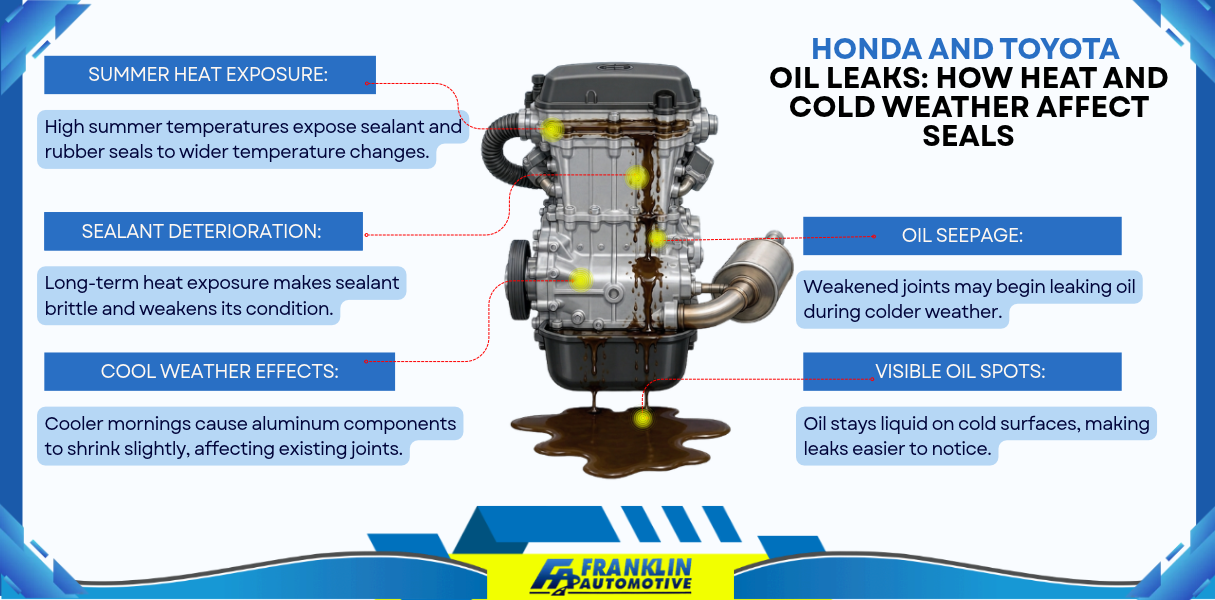
Heat is the accelerant here. A car that spends its summers parked outside around Homewood or Vestavia runs its sealant and its rubber seals through a wider temperature swing than the same car would see further north, and sealant that has been baked for ten years is brittle before it is old. The cooler mornings we get from December onward then shrink the aluminum slightly, and a joint that had been holding by a thread starts to weep.
These leaks tend to get noticed now for a second reason. You park over a cold slab, the oil stays liquid on it instead of cooking off, and the spot finally shows.
If the car is still inside its factory warranty
A sealant seam that lets go on a low-mileage car is a warranty conversation with the dealer before it is a repair order. Worth knowing in that situation: having your oil changed at an independent shop does not put that coverage at risk. The Federal Trade Commission states plainly that you do not have to use the dealer for repairs or maintenance to keep your warranty in effect, and it is illegal for a dealer to deny coverage because routine maintenance was done by someone else.
Keep your receipts, bring the car to whoever you trust, and let the warranty claim stand on the defect itself.
Confirm the Source Before You Buy the Repair
The underside gets cleaned, the car goes back to you for a few days, and the next look on the lift shows the exact joint the oil is leaving from.
Franklin Automotive — 2880 Acton Rd, Birmingham, AL 35243