2880 Acton Road,


That Drip Between Your Engine and Transmission in Birmingham Is Probably the Rear Main Seal
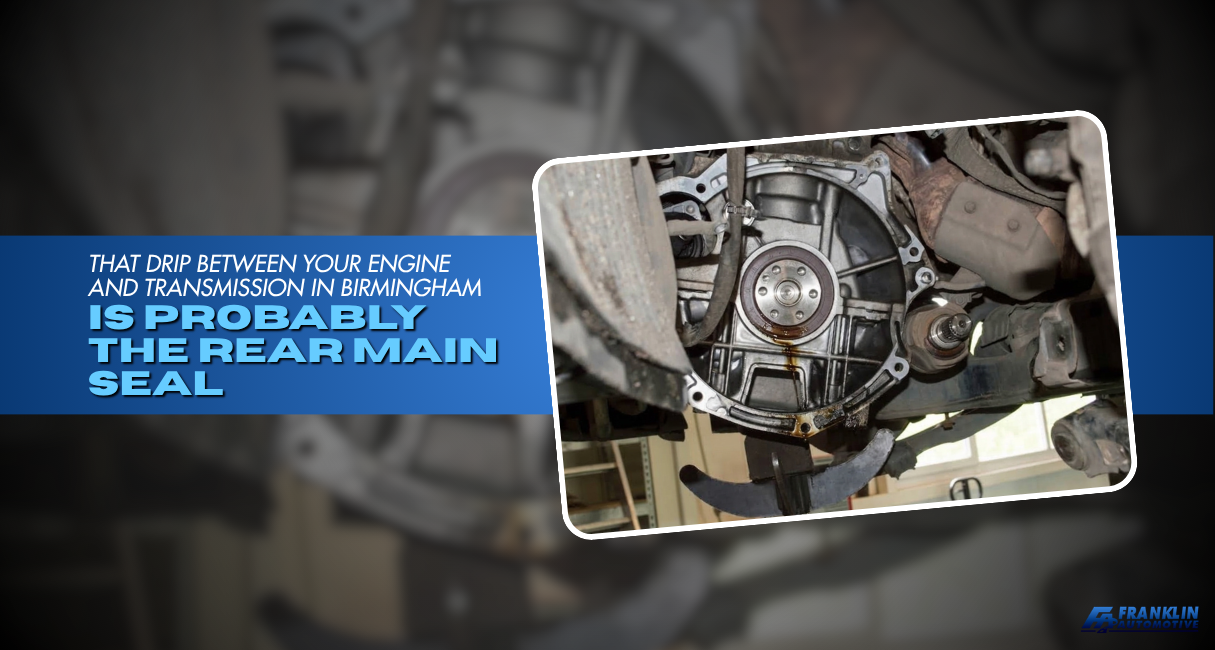
You back out of the driveway in Vestavia and there’s a fresh dark spot on the concrete. Not near the front of the car. Right in the middle, under the bellhousing where the engine bolts to the transmission. That location narrows things down fast, and on most imports it points at the rear main seal — the crankshaft seal at the very back of the engine.
It’s a small part in an awkward place. Franklin Automotive has been diagnosing import oil leaks at 2880 Acton Road since 1992, and the reason we take this one seriously in autumn is simple: a seal that seeps in warm weather often runs faster once mornings get cold and the oil thickens.
Quick Summary: Key Takeaways
- Location is the clue: a leak centered where the engine meets the transmission, and worst after the car sits, usually means the rear main seal.
- It is often not the seal’s fault: high crankcase pressure from a blocked breather system pushes oil past a seal that was fine.
- Don’t guess from above: oil travels, so a valve cover or oil cooler leak can look identical from the driveway.
- Access is the cost: the seal is inexpensive; reaching it means separating the transmission from the engine.
- Ignoring it gets expensive: oil on a clutch, a rear crank sensor or a flexplate turns a leak into a different repair.
The rear main seal keeps oil in at the back of the crankshaft
Your crankshaft has to pass out of the block to reach the flywheel or flexplate. The rear main seal is the ring that wraps that exit point and keeps engine oil inside.
It’s usually a molded rubber lip seal, sometimes carried in a housing, and it spends its life riding a spinning shaft under constant heat. Over enough years the lip hardens, loses its spring tension, and stops conforming to the crank — and because the seal sits at the lowest, most hidden point on the engine, the first evidence most owners get is a puddle rather than a smell.
Cheap part. Difficult location.
How we tell a rear main leak from everything above it
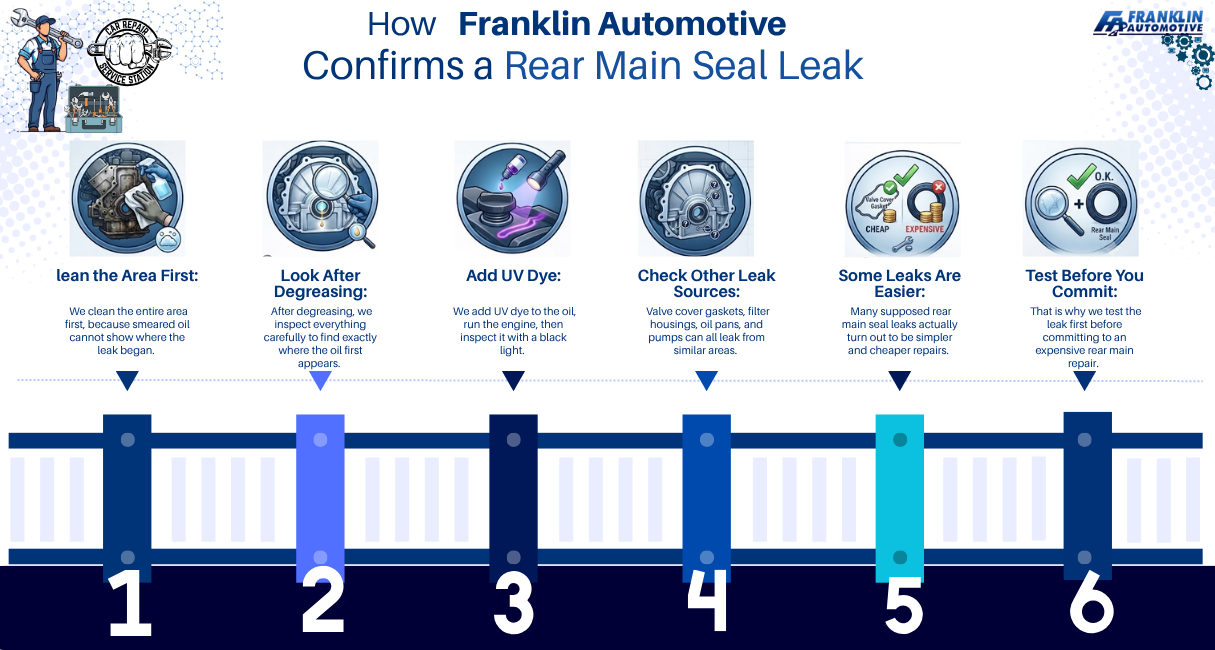
We clean the whole area first, then we look. Oil already smeared across the underside of an engine tells you nothing about where it started. Nothing at all.
After degreasing we add UV dye to the oil, run the engine, and inspect with a black light on the lift — that shows the actual origin instead of the runoff path. A valve cover gasket, an oil filter housing, an oil pan rail or a transmission front pump can all end up dripping from the same spot on the ground. Plenty of the “rear main seals” people bring us turn out to be something easier and cheaper, which is a good reason to test before you commit.
Crankcase pressure is the cause people miss
A rear main seal usually fails for a reason. The reason is often pressure — if the engine’s breather system is plugged, combustion gases have nowhere to go and the crankcase pressurizes.
That pressure looks for the weakest exit, and the rear main seal is frequently it. Replace the seal without fixing the breather and the new seal will weep too, sometimes within months, which is why we check crankcase ventilation on every leak we quote. Ask any shop that has warrantied a rear main job twice. They check it now.
What a leak costs you if you keep topping it off
Topping off is not a repair. It’s a countdown.
Oil on a manual clutch disc means slipping and a clutch job you didn’t need. Oil reaching a rear crankshaft position sensor causes intermittent stalling that looks electrical and gets misdiagnosed. And used oil doesn’t only cost you money — the U.S. Environmental Protection Agency notes that the used oil from a single oil change can contaminate one million gallons of fresh water, a year’s supply for 50 people. What drips on your driveway ends up somewhere.
Doing it right means doing it once
Reaching the seal means dropping the transmission or the subframe, depending on the car. So we inspect while it’s open.
Flexplate bolts, the pilot bearing, the crankshaft sealing surface, the clutch on a manual, and the crankcase breather all get checked before the new seal goes in, because a second teardown for a $30 part nobody looked at is the outcome we’re trying to avoid. We have 26 service bays, ASE-certified technicians, and a minimum 12-month, 12,000-mile warranty on the work.

Birmingham import owners have somewhere local for this
Eleven makes come through here: Acura, Audi, Honda, Hyundai, Infiniti, Lexus, Nissan, Porsche, Subaru, Toyota and Volkswagen. Porsche is the newest addition, worked by the same crew in the same bays on Acton Road, which is exactly how a shop should add a marque.
Loaner cars, a shuttle within ten miles of the shop, and after-hours drop-off keep a two-day job from wrecking your week. Homewood, Hoover, Mountain Brook, Pelham, Trussville and Vestavia drivers are all a short run away. Bring us the spot on the driveway.
Frequently Asked Questions
Q: How do I know if my rear main seal is leaking?
A: Look for oil centered where the engine meets the transmission, heaviest after the car has been parked, with clean areas ahead of it. Confirmation takes a degrease and a dye test, since leaks from above run down to the same place.
Q: Can you drive with a leaking rear main seal?
A: Short term, if you monitor the oil level closely. But a seep becomes a run, and oil reaching a clutch or a crank sensor creates problems that cost far more than the seal. Have it inspected rather than watching it.
Q: Why is rear main seal replacement expensive?
A: The seal itself is cheap. Getting to it means separating the transmission from the engine, and that is most of the labor. It’s also why we inspect everything back there while access is open.
Q: Will a stop-leak additive fix a rear main seal?
A: No. Additives swell rubber temporarily and can affect other seals in the engine. We don’t recommend them on any import we service — they postpone the diagnosis and sometimes make it harder.
Bring the leak to Franklin Automotive in Birmingham
If your car is leaving spots on the driveway this autumn, let us find the source before you buy parts. A dye test costs a fraction of a wrong repair.
Franklin Automotive — 2880 Acton Rd, Birmingham, AL 35243Hours: Mon–Fri 7:00 AM – 5:30 PM; Sat–Sun closed
Website: franklinautomotive.com