2880 Acton Road,


Honda Electrical System Faults: What Birmingham Drivers Need to Know
Honda‘s reputation for long-term reliability is well-deserved, but as these vehicles age and accumulate miles, electrical system faults have become an increasingly common reason drivers visit us at Franklin Automotive in Birmingham. Unlike older Hondas that were relatively simple in their electronics, models from the late 2000s onward are loaded with interconnected control modules, CAN bus networks, and driver assistance systems that can develop faults in ways that weren’t possible on earlier generations. Understanding what’s happening under the hood helps Honda owners make informed decisions and avoid unnecessary repairs.
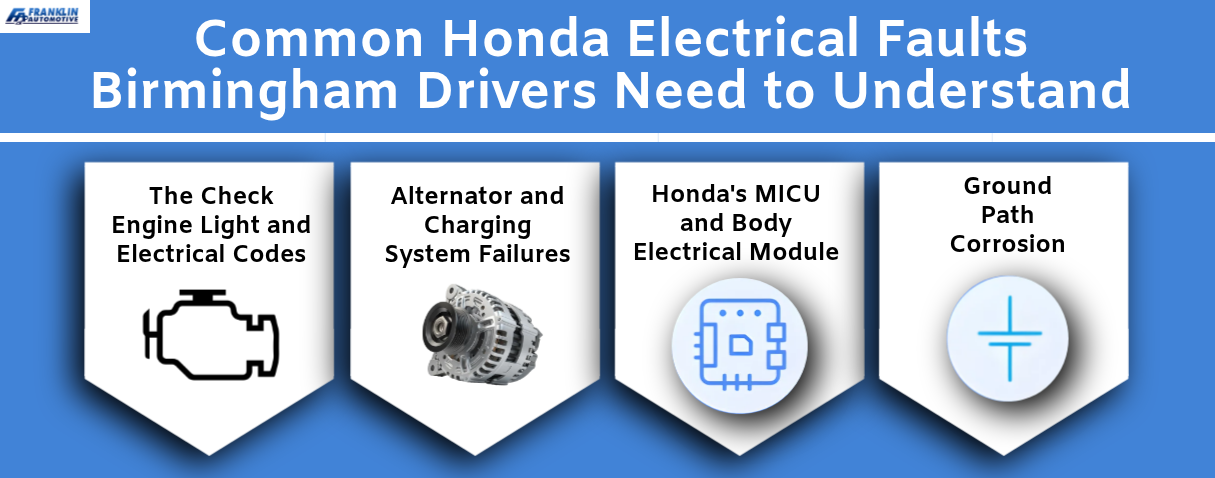
The Check Engine Light and Electrical Codes
Not every check engine light on a Honda points to a mechanical problem. A significant portion of the fault codes we retrieve point to electrical issues — sensor failures, communication faults between modules, or circuit voltage irregularities. Common electrical-related codes on Honda Accords, Civics, CR-Vs, and Pilots include P0562 (system voltage low), P0600 series (serial communication link malfunction), and U0xxx codes indicating loss of communication between specific control modules.
These communication faults are often the first visible sign that something broader is affecting the electrical system — whether it’s a weakening battery, a ground path issue, or a failing alternator that isn’t maintaining the stable voltage modern electronics require. A generic code reader pulls these codes, but proper diagnosis requires factory-level Honda diagnostic software (Honda i-HDS or equivalent) to read the freeze frame data, examine module communication status, and determine whether the fault is intermittent or current.
Alternator and Charging System Failures
Honda alternators in the 2008–2016 generation across multiple platforms have a pattern failure involving the internal voltage regulator. The regulator’s job is to maintain stable charging voltage between 13.5 and 14.5 volts regardless of engine load and accessory demand. When the regulator degrades, it can allow voltage to fluctuate outside this range — too high causes module damage and battery overcharge; too low causes the battery to discharge under normal driving conditions.
The confusing aspect of alternator voltage regulator failure is that the charging warning light often doesn’t illuminate until the fault is advanced. In the early stages, the symptom is electrical gremlins — lights flickering at idle, infotainment system rebooting, power windows operating sluggishly, or the audio system cutting out briefly. These symptoms correlate with voltage spikes or drops that disrupt module operation without fully discharging the battery or triggering a charge warning. A charging system test with an oscilloscope-capable load tester identifies this type of failure by showing voltage waveform irregularity rather than just average voltage.
Honda’s MICU and Body Electrical Module
The MICU (Multiplex Integrated Control Unit) is Honda’s body electrical management module — it controls interior and exterior lighting, accessory power circuits, windows, and communication between body-related control modules. MICU faults can produce a wide range of puzzling electrical symptoms: interior lights that stay on after the door closes, power accessories that don’t respond, or locks that cycle on their own.
One of the most frequently misdiagnosed MICU-related issues is a cabin battery drain. Because the MICU manages sleep mode for accessories, a failing MICU that doesn’t properly wind down after the car is locked will keep multiple accessory circuits active through the night. The owner wakes up to a dead battery, replaces it, and the problem recurs — because the battery was the victim, not the cause.
MICU replacement on Honda vehicles requires careful programming to match the vehicle’s specific configuration, and in some cases the module needs to be registered with Honda’s keyless system if the locks and remote entry are to function correctly after the swap.
Ground Path Corrosion
Honda vehicles, particularly those in the Birmingham area that see combination use on highways and older roads, develop ground path corrosion at specific chassis ground points over time. Honda’s electrical architecture depends on multiple ground locations that connect control modules, sensors, and accessories to the chassis. When these grounds develop resistance from corrosion at the bolt connection, the entire circuit sees elevated voltage that confuses sensors and causes intermittent faults.
Ground issues on Honda are particularly deceptive because the symptoms change with temperature and humidity — a corroded ground may behave normally in dry summer heat but produce misfires, random electrical faults, or a harsh idle during Alabama’s humid spring mornings. Cleaning or replacing corroded ground strap connections is one of the highest-value, low-cost repairs in Honda electrical diagnosis.
Contact Franklin Automotive in Birmingham
If your Honda is showing electrical faults, mysterious warning lights, or exhibiting behavior you can’t explain, contact Franklin Automotive at (205) 969-2886 or visit us at 2880 Acton Road, Birmingham, AL 35243. Our technicians use Honda-specific diagnostic tools to get to the actual root cause rather than replacing parts until something works.
Frequently Asked Questions
Why do Honda electrical problems often appear suddenly without warning?
Many Honda electrical systems are tolerant of degrading components until a threshold is crossed. A battery may function adequately for months while slowly losing capacity until one cold morning, it can’t deliver sufficient cranking current. Similarly, a MICU module may work correctly until heat, humidity, or a minor voltage spike pushes a borderline internal component to failure.
Can a weak battery cause multiple electrical fault codes on a Honda?
Yes. Low or unstable voltage causes control modules to log fault codes that look like sensor or system failures but disappear after the battery is properly charged or replaced. Always verify battery health before diagnosing downstream electrical faults on any modern Honda.
My Honda’s lights flicker briefly at idle — is this serious?
Flickering lights at idle typically indicate a charging system issue — either an alternator voltage regulator problem or a failing alternator diode pack. Have the charging system tested under load and with an oscilloscope if possible to catch intermittent voltage irregularities that a basic voltage check would miss.
Does Franklin Automotive service all Honda models?
Yes. We service the full Honda lineup, including Civic, Accord, CR-V, Pilot, Ridgeline, HR-V, Odyssey, and Passport, as well as Acura models that share Honda platform architecture.